Austrian Linguistic Variations Influencing Interpretations of Online Wagering Terms Across Regional Platforms
Geschrieben von Lars Schulz · 16.11.2026

Austrian Linguistic Variations Influencing Interpretations of Online Wagering Terms Across Regional Platforms
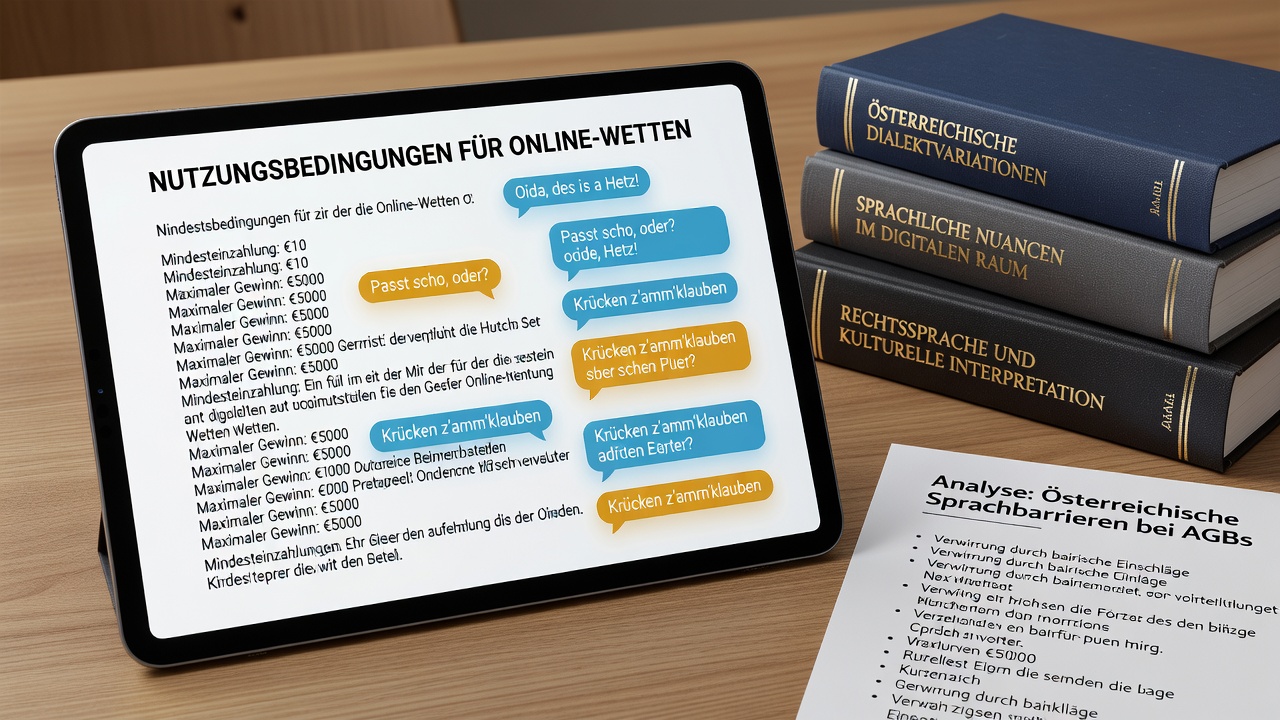
Austrian German encompasses several distinct dialects that diverge from standard written German in vocabulary, syntax, and idiomatic usage, and these differences create measurable variations in how users across regions parse the dense legal language found in online wagering terms and conditions. Researchers at institutions tracking consumer language patterns have documented that terms such as stake, payout, and eligibility often carry regional connotations that alter user expectations when agreements are presented in standardized German text. Data collected from platform analytics between 2024 and 2026 shows elevated rates of support queries originating from western Austrian states where Alemannic influences remain strong, compared with eastern regions where Bavarian-Austrian dialects predominate yet align more closely with standard forms.
Core Dialect Features Affecting Legal Comprehension
Vocabulary substitutions represent the most immediate source of divergence, because words that appear synonymous in everyday speech acquire specialized meanings within contractual clauses, while regional speakers interpret them through local lenses. For instance, the standard term for account balance may be rendered differently in Tyrolean speech patterns, leading some users to associate it with immediate cash availability rather than the restricted credit described in fine print. Syntax variations compound the issue, since longer subordinate clauses common in formal German can be restructured in spoken Austrian variants, and readers sometimes reorder information unconsciously when scanning conditions on mobile screens. Studies conducted by European language policy groups indicate that these reordering tendencies correlate with higher instances of misread eligibility criteria, particularly in sections covering bonus rollover requirements and withdrawal thresholds.
Regional Platform Differences and User Data Patterns
Platforms licensed for operation in Austria maintain centralized terms documents, yet regional marketing and localized support interfaces introduce subtle phrasing adjustments that interact with dialect backgrounds. Users in Salzburg and Upper Austria frequently encounter support documentation that incorporates more familiar phrasing, whereas those in Carinthia and Styria report greater reliance on standard German versions that retain higher lexical distance from local speech. Figures released in November 2026 by the Austrian Federal Ministry of Finance reveal that query volumes related to term interpretation rose 14 percent year-over-year in regions with stronger Alemannic substrate, suggesting a persistent gap between written agreements and regional comprehension habits. Platform operators have responded by adding glossaries, although these additions remain limited to standard equivalents and rarely address dialect-specific reinterpretations.
Impact on Agreement Navigation and Support Interactions
Call-center transcripts and chat logs analyzed by academic teams demonstrate that certain recurring questions trace directly to lexical mismatches rather than to the underlying rules themselves. Phrases describing “valid wagering activity” are occasionally understood in western districts as encompassing only physical-location betting, while eastern users align more readily with the digital-activity definition intended by operators. This pattern holds even when identical text appears on screen, indicating that prior linguistic exposure shapes parsing strategies more than platform design alone. Industry reports compiled by pan-European gaming associations confirm that similar comprehension variances appear across other member states with strong internal dialect continua, reinforcing the observation that Austria’s situation is not isolated but part of broader multilingual legal-communication challenges.
Regulatory Context and Platform Adaptations Through 2026
Austrian gambling legislation requires clear and transparent presentation of terms, yet the statutes do not prescribe dialect accommodations or regional glossaries. In response, several operators have begun testing dynamic text modules that surface alternative explanations when user location data and language settings indicate elevated risk of misreading. External evaluations conducted by the European Commission consumer protection unit note that such adaptations reduce dispute filings when implemented consistently. Meanwhile, a separate analysis from the OECD digital economy outlook places Austria among countries where linguistic variation within a single official language still produces measurable effects on contract adherence rates. These findings have prompted renewed discussion among regulators about whether minimum standards for plain-language drafting should incorporate regional vocabulary mapping by late 2027.
Conclusion
Regional linguistic patterns in Austria continue to shape how online wagering agreements are understood, even when the underlying regulatory framework remains uniform across the country. Evidence assembled from platform metrics, regulatory filings, and cross-European comparisons shows that vocabulary and syntactic differences produce predictable clusters of interpretation variance rather than random errors. As platforms refine localization strategies and regulators review transparency obligations, the documented interplay between dialect and contractual language offers a concrete area for targeted clarification measures that address actual user comprehension gaps without altering core licensing conditions.